
Dana Point Resident Lookup Coverage
A one-person search works best when each record is treated as evidence with a narrow purpose. Dana Point has no separate municipal court, recorder, assessor, or vital-record bureau, so the trail runs through Orange County offices and California agencies. A property roll can connect an APN to value and exemptions. A deed index adds named parties and parcel continuity. Court, voter, vital, business, and license records answer different questions, and none is a complete household roster.
| Record | What It Confirms | Where | Access |
|---|---|---|---|
| Property roll | APN, value, exemptions, and ownership context at the counter | Orange County Assessor | Online APN only; owner name suppressed |
| RecorderWorks index | Grantor or grantee, party role, instrument, and parcel continuity | Orange County RecorderWorks | Free index; no image; copy request |
| Court record | Case number, filing date, parties, docket events, and status | Orange County Superior Court | Number route or enrolled name search |
| Voter record | Your own status, mailing address, party, history, and districts | OC Vote self lookup | Authenticated self use; qualified file route |
| Vital record | Birth, death, marriage, relationship, and event date | OC Clerk-Recorder or CDPH | Eligibility and copy type apply |
| Business or license file | Entity affiliation, agent or officer filing, status, and discipline | California SOS or DCA | Free public search; scope varies |
Start with the strongest identifier available. When you look up a resident, an address can lead to a parcel and a deed; a case number can avoid a paid party-name search; a license number can separate two people with the same name. A voter search is for the voter’s own record, not an open street browse. Treat a matching name as a lead until a second record agrees.
Dana Point Resident Name Match
The Orange County RecorderWorks index is the named-party route for deeds and other recorded instruments. Search in last-name-first form, without punctuation. A last name alone works, while a partial first name and the portal’s Allow Partial Match control can help with a variant. The index covers January 4, 1982 to the present. It can connect a Dana Point name to an instrument or APN, but it does not show a document image.
| RecorderWorks field | How it works | Use in a resident match |
|---|---|---|
| Party role | Grantor, Grantee, or Grantor/Grantee | Compare the person’s role in the transfer |
| Person or business name | LAST FIRST; partial names accepted | Test spelling and trust or entity variants |
| Recording dates | From and through fields use MM/DD/YYYY | Narrow a deed search to a known period |
| Document number | Separate mode; post-1982 numbers use year plus six digits | Open one known index entry |
| APN | Conditional parcel-number mode | Follow a property when the name is common |
| Document type | Conditional controlled list | Focus on a grant deed, lien, or related instrument |
| Legal description | Multiple text controls | Compare parcel identity beyond the street address |
Recording dates can run through the current day, although the newest day may be partial. Clicking a document number opens metadata, party links, references, and the shopping-cart path, not a scan. Office kiosks allow searching and free viewing, but recorder staff will not perform the grantor-grantee search by phone, mail, or in person. Pre-1982 requests need book, page, and instrument references from Santa Ana microfiche. Copies cost $1 per page plus $1 for certification of a document or map. When the question shifts from one name to everyone along a road, the Dana Point street directory page keeps the address work in its proper lane.
Orange County Court Name Search
Orange County Superior Court splits one-person research across different routes. Case Access and Case Index are case-number driven. Calendar can accept a party name along with the case number or calendar and type controls. The enrolled Case Name Search requires an account and credits. International remote access is prohibited, so a result that is not available online may require the Records Unit or a courthouse terminal.
The Name Search FAQ recommends Exact rather than Similar and caps results at 500. Data refreshes daily, with a 2:00 to 2:15 a.m. Pacific downtime window and general maintenance around 6 to 7 p.m. A match returns case numbers and filing dates; selecting a case exposes its register of actions. Sealed or confidential matters, paternity matters, and other minor matters are unavailable. Unlawful detainer names are withheld for the first 60 days under Code of Civil Procedure section 1161.2. California Rule of Court 2.503 calls for reasonable access unless a matter is confidential or sealed, while allowing courthouse-only access for sensitive types.
The published name-credit schedule supports 1 credit for $1.50, 5 for $5, 10 for $9, 75 for $70, and 30-day unlimited access for $400. Civil document copies are listed at $7.50 for the first ten pages, $0.07 per later page, and a $40 cap per document. Those fees apply to the named services; Case Access and Calendar do not become a full file merely because a number or party is visible.
The Orange County Superior Court Case Name Search entry page shows the enrolled party-name route before a query is run.
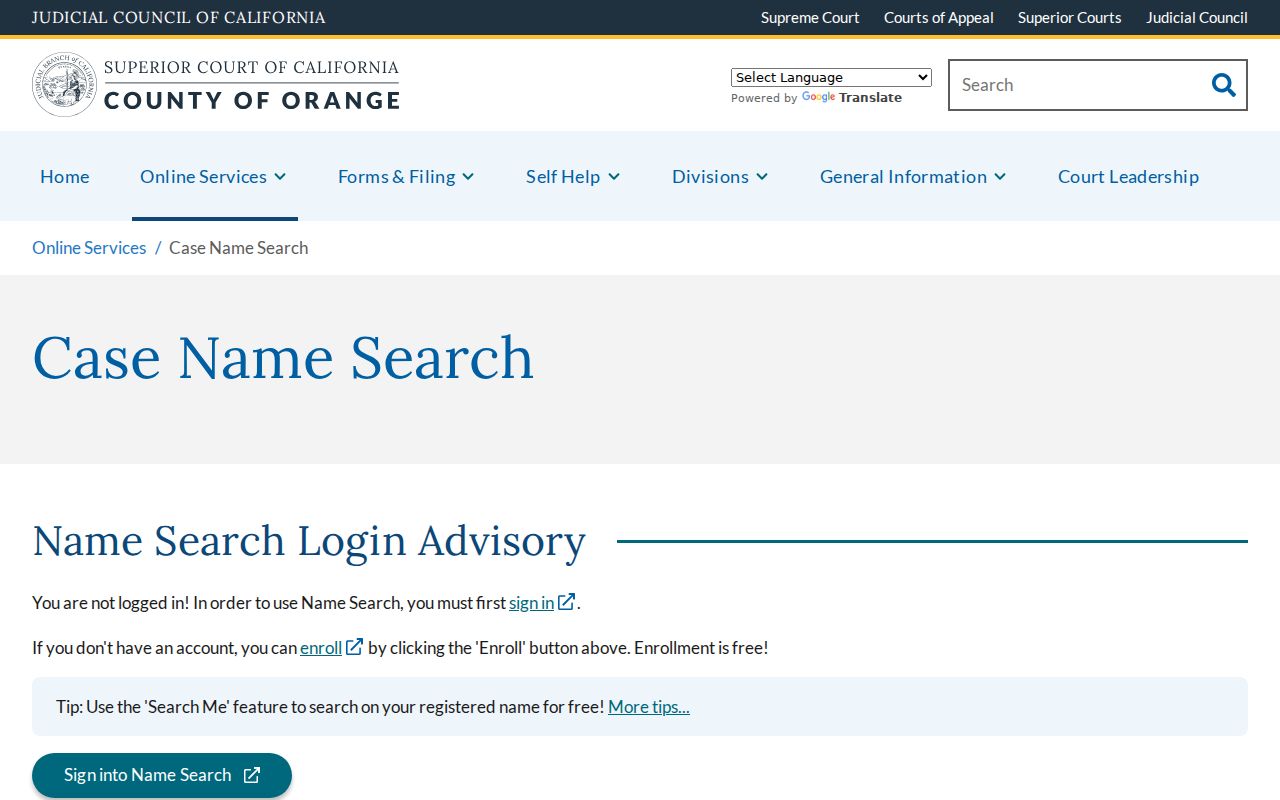
The enrollment gate explains why a free case-number check and a paid name search should not be treated as the same search.
The court’s official Case Name Search FAQ describes the 500-result ceiling, refresh cycle, and unavailable case categories.
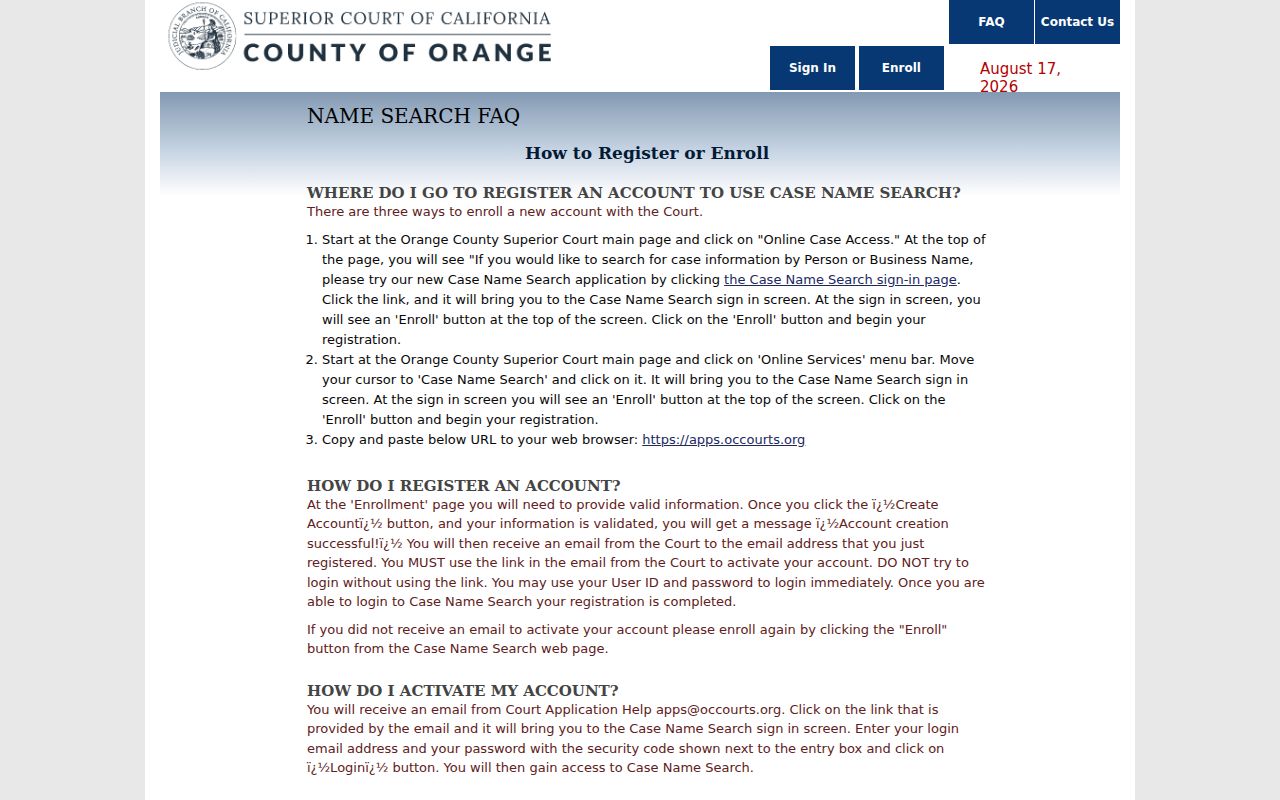
Use Exact first, record the case number and filing date, then read the public register rather than assuming a name match proves identity.
| Case number and type | Identifies the matter and its division. |
|---|---|
| Filing date | Places the match on a time line. |
| Parties and roles | Shows how each named person appears in the case. |
| Register of actions | Lists public filing and event entries. |
| Officer, department, and hearings | Shows the judicial officer or department and permitted hearing dates. |
| Disposition or status | Reports the public case outcome or current state. |
| Document links and payment gates | Shows links or charges only for documents the public route permits. |
For a public matter missing from remote access, the Central Justice Center Records Unit is at 700 Civic Center Drive West, first floor, Santa Ana, open Monday through Friday from 8 to 4. The unit lists (657) 622-8736, cjcrecordsmanagement@occourts.org, and the L-3009 copy request. Courthouse terminals can show a public matter that the remote gateway does not expose.
Note: A case number and filing date help separate same-name parties before a public docket is tied to one resident.
Dana Point Resident Verification
Verification is a chain, not a single hit. For a known person and a known Dana Point address, the goal is to connect the parcel, deed, and independent record without treating an owner as proof of every resident.
- Write down the exact name, known address, and any date or case clue. Keep alternate spellings and a last-name-first version.
- Convert the address to the parcel’s APN. The Assessor’s public web form accepts exactly eight numeric digits and suppresses owner-name searching, so use the parcel map or a public counter when the address is the key.
- Run RecorderWorks by name or APN. Add a recording date range in MM/DD/YYYY format, compare grantor and grantee roles, and note co-parties, trusts, entities, and legal-description clues.
- Compare the latest deed with current Assessor counter information and the mailing or situs address. A matching mailing address is owner-occupancy evidence, not a list of household members.
- Use a court calendar, case number, business filing, or license result as a second independent fact. Middle names, age or date clues, party roles, and county context help separate same-name results.
- Only the voter can authenticate the self-lookup. If official proof is needed, request a certified copy from the responsible custodian. Never enter another person’s date of birth, ID digits, or Social Security digits in the self-only voter tool.
- Docket
- A court case’s running list of public filings and events. It is not the entire case file.
- Index versus image
- An index supplies metadata such as a name, date, type, and reference. An image is the scanned document or page obtained through the custodian, when available.
- Certified copy
- A copy issued and certified by the office that holds the record. It is different from a web index entry or an uncertified PDF.
That distinction prevents overclaiming. A RecorderWorks entry can point to a deed without showing its signature or full legal description. A court docket can show a disposition without opening a sealed filing. A vital index can identify an event without granting access to the certificate.
Dana Point Vital Records Access
The Orange County Clerk-Recorder issues birth and death certificates for events in the county and marriage certificates for marriages it licensed. It does not issue divorce decrees. Events within 60 days may route through the Orange County Health Care Agency at (714) 480-6700. In-person applications require pre-application and government photo ID, and usually receive same-day service. Central Santa Ana hours are 8 to 4:30; Anaheim and Laguna Hills are 9 to 4:30.
Mail requests go to PO Box 238, Santa Ana, California 92702, with a notarized signature and check or money order. Most mail orders take 5 to 10 business days after receipt, and the search fee is retained when no record is found. An authorized copy requires a statutory relationship or another listed qualification. Categories include the registrant, parent or guardian, child, grandparent or grandchild, sibling, spouse or domestic partner, court-order holder, qualifying attorney or adoption agency, an official government or law-enforcement requester, an estate representative, and a funeral employee handling death duties.
An informational copy generally carries the words “INFORMATIONAL, NOT A VALID DOCUMENT TO ESTABLISH IDENTITY.” Confidential marriage records have no informational copy, and ordinary access is limited to a spouse or party. Adoption records and original birth records remain confidential without the statutory or court process. California does not open vital certificates under a blanket 50-year or 100-year rule. Historical indexes can identify an event, but they do not turn a restricted certificate into an open record. CDPH maintains statewide records and issues certified copies through its state application route.
For 2026, Orange County lists $34 for a birth certificate, $26 for a death certificate, and $19 for a marriage certificate. The current California vital-record fee page lists $31 for birth, $26 for death, $19 for marriage, and $18 for a dissolution certificate. Check the custodian and copy type before paying because older application revisions can show stale amounts.
Note: A historical vital index can identify an event, while eligibility and copy type still control access to the certificate.
Dana Point Voter Lookup
The Orange County Your Voter Information lookup is authenticated self-service, not an open Dana Point name or street directory. It asks for three exact fields:
- Date of birth in mm/dd/YYYY format.
- The last four digits of a driver license or California ID, or the last four digits of a Social Security number if no license or ID exists.
- The first three letters of your first name, exactly the first three characters.
After verification, the voter can see registration status, name, mailing address, voter status, political party, registration history, and elected districts and officials. The same service supports ballot and sample-ballot features and address confirmation. It does not provide open street browsing, and a requester must not test another person’s credentials.
A separate qualified data request is not a casual name search. Orange County’s voter-data application route requires an original wet signature, in-person or mail submission, not email or fax, a permitted-purpose narrative, supporting proof, a security and confidentiality explanation, a photo-ID copy, and prepayment. A specific-record request can identify up to ten voters with first and last name, date of birth, address, and other facts. The county accepts the listed payment and delivery options but promises no fixed turnaround. Elections Code sections 2187 and 2194, Government Code section 7924.000, and 2 CCR section 19003 keep this file purpose-limited.
The self-lookup form makes clear why a Dana Point resident lookup should not treat voter data as a third-party directory.
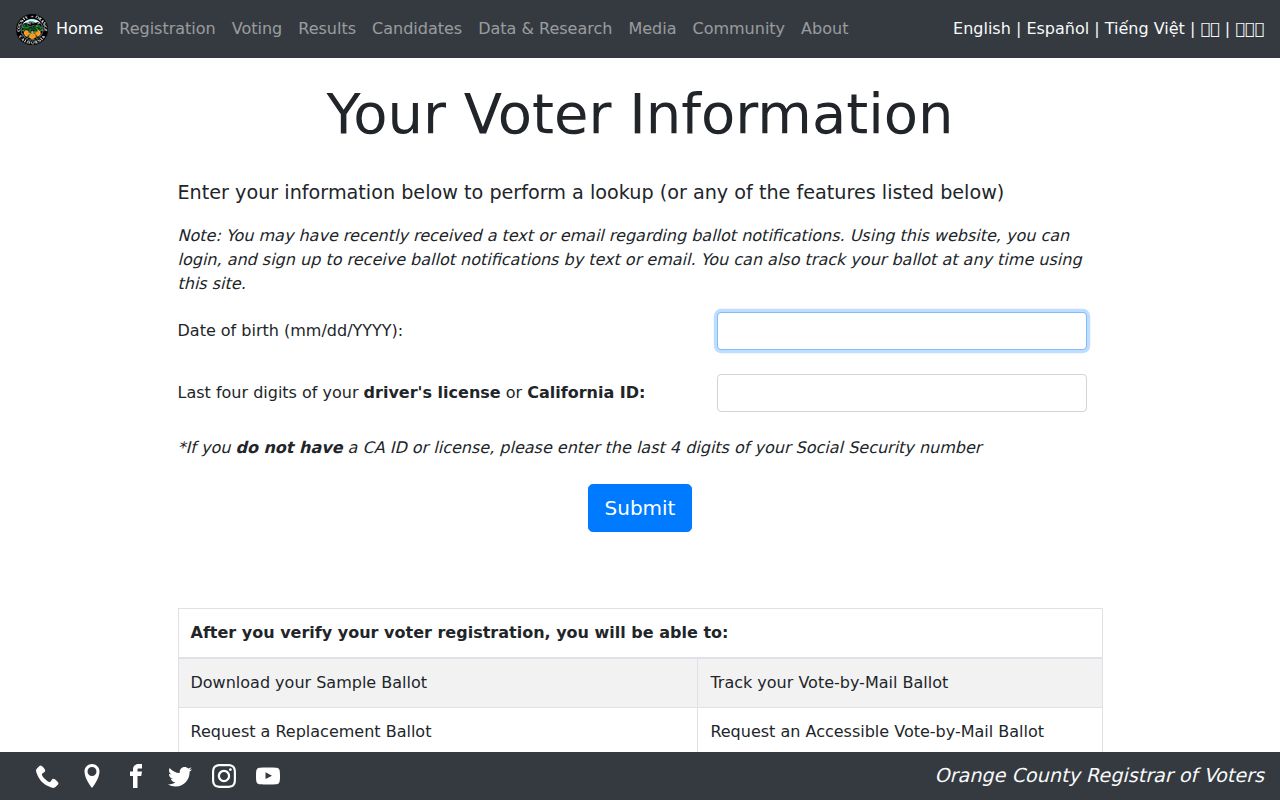
The result is designed for the voter’s own status and address confirmation, while broader access follows a separate statutory application.
Dana Point Resident License Checks
Business and professional files can confirm an affiliation without turning a business contact into a residence. California’s Secretary of State bizfile search accepts an entity name or file number. Names need at least three characters, and a legacy leading “C” is removed from an entity number. Basic results are capped at the 500 closest matches; Advanced adds entity group or type, status, initial filing-date range, Publicly Traded Disclosure, and a starts-with refinement.
The California bizfile Business Search shows the state’s entity-name and file-number route.
It covers corporations, LLCs, LPs, cooperatives, and nonprofits. LLPs and general partnerships require the paper order form. Plain PDF images are free among more than 17 million documents. Detail pages can show legal name, entity number, formation or conversion date, status, FTB, SOS Agent, and VCFCF standing, jurisdiction, street and mailing addresses, agent-for-service information, Statement of Information due date, officers, directors, members, or managers where filed, filing history, and PDF images. SOS does not collect ownership, phone or email, subsidiaries, bylaws, operating agreements, or EINs.
The Department of Consumer Affairs search uses Board or Bureau, License Type, License Number, Business Name, First Name, and Last Name. Public results can show license status and discipline. Specialty boards outside the DCA umbrella need their own official route, and a license address is an affiliation clue rather than proof of a Dana Point home.
The California Department of Consumer Affairs license search displays the public field set used to separate a professional record from a same-name result.
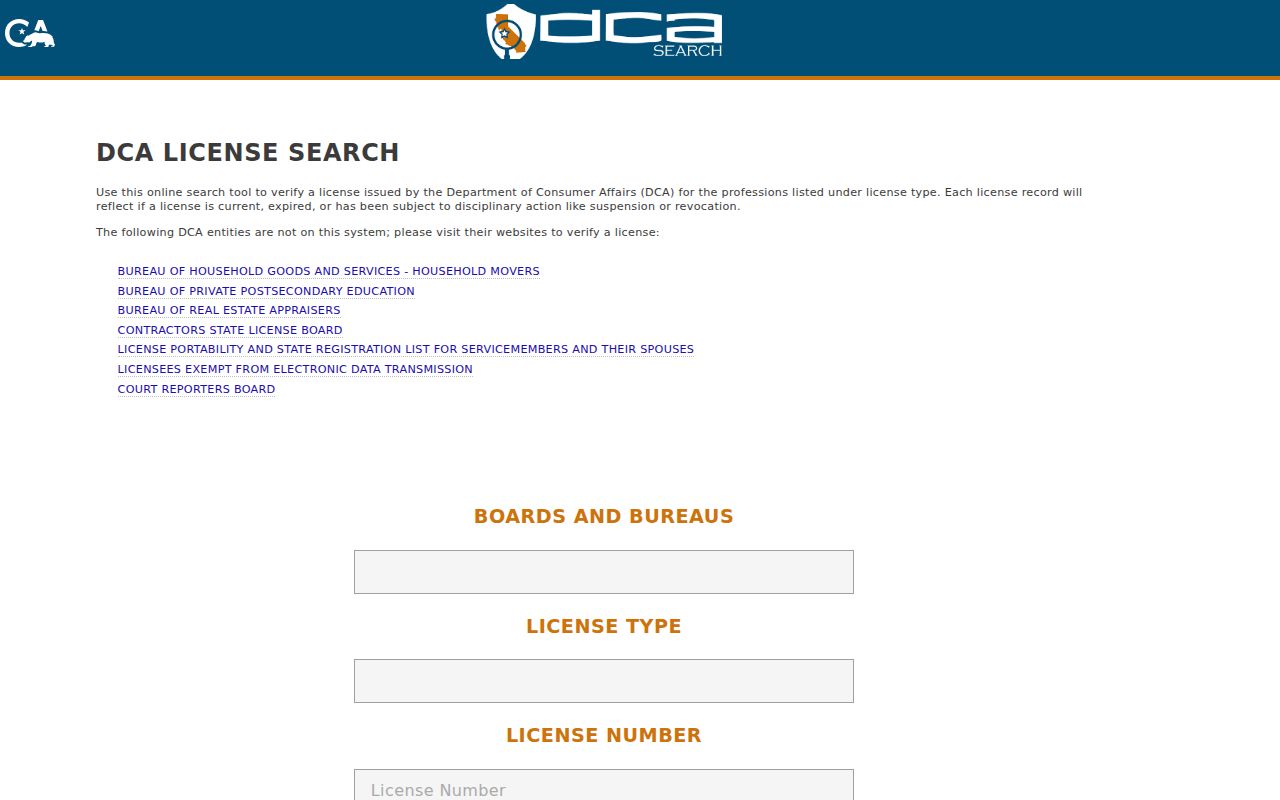
Read the license number, board, status, and discipline together. A name by itself is not enough to join a license, business filing, deed, or court case to one Dana Point resident.
Note: A license or business address shows an official affiliation, not necessarily a home address or current residence.
Dana Point Resident Record Routes
To look up a resident for an heir question, use an official path. Orange County Superior Court probate petitions and notices may identify a personal representative, heirs, or addresses, while estate and trust deeds can bridge successors in the recorded trail. Public filings still have sealed, redacted, and access-limited parts. Use the probate case route and the recorded instrument reference together rather than treating a single party name as the whole family story.
Birth-parent and adoptee research follows a different rule. California adoption records and original birth records are confidential. The proper route is the state’s consent-based adoption and reunion process, not a public adoption name index. A former classmate can be corroborated through Dana Hills High yearbooks and local-history or alumni sources, but those sources do not establish a current address. For historical address context, the Dana Point city directory page keeps the older collection trail separate from current record verification.
When a local Dana Point record is not online, use the city’s public-record request form or California Public Records Act channel. The city’s ten-calendar-day statement is a determination period, not a promise that production will be complete within ten days.
Dana Point Resident Lookup Limits
California privacy rights can correct a business copy without rewriting a source record. The California Consumer Privacy Act, Civil Code section 1798.100 and following, supports access, deletion, correction, sale or sharing opt-out, sensitive-information limits, and nondiscrimination, subject to exceptions. Publicly available government-record information is generally exempt. A correction request can target a wrong commercial entry, but it does not erase a deed, Assessor entry, court record, or voter record. Send a correction to the custodian that made the record: Assessor, recorder, Registrar of Voters, court, or licensing board.
California’s Delete Act created DROP, the Data Broker Registration and Opt-Out Platform. The state describes one request that can reach more than 500 registered brokers. A consumer confirms California residency and creates an encrypted matching profile; broker processing begins August 1, 2026. Supplying more identifiers can improve a match, but it also increases the data shared for that request. DROP and a company opt-out can reduce a commercial copy, not remove the public source. Orange County’s real-estate fraud alert is automatic and free rather than opt-in; it mails an owner a notice and first-page copy when an affecting instrument records, but it supplements rather than replaces index checks.
Safe at Home is address substitution and confidential mail forwarding, not a promise to erase every historical reference. The California Safe at Home program serves qualifying victims of domestic violence, stalking, sexual assault, child abduction, elder or dependent-adult abuse, and human trafficking, along with certain reproductive or gender-affirming care affiliates and public employees facing work-related threats. Government Code section 6208.1(b) prevents public display of a participant’s home address and phone after a written nondisclosure demand. Voter street address, phone, email, precinct identifier, prior registration data, driver or state-ID number, Social Security or unique voter identifiers, and signature are confidential except through the permitted Elections Code route. Permitted purposes include election, scholarly, journalistic, political, and governmental work. DMV customer address data is also closed under the federal Driver’s Privacy Protection Act.
Lawful use. A Dana Point resident lookup is for personal, lawful research. Public access does not authorize stalking, harassment, intimidation, or threats. California Penal Code section 646.9 addresses willful, malicious, repeated following or harassment paired with a credible threat, and Code of Civil Procedure section 527.6 provides a civil-harassment restraining-order process. Voter-file use outside permitted purposes can be a misdemeanor under Elections Code section 18109.