
Dana Point City Directory Holdings
Historical directory evidence for Dana Point is distributed across federal, county, library, and society collections. The strongest verified run is not a complete city series. NARA names Dana Point in three Orange County volumes, while Orange County Archives describes collection-specific county holdings. OCPL supplies licensed digital searching and branch newspapers. FamilySearch adds marriage and death indexes, and the federal census supplies a decade-by-decade household check. The table separates a named year from an unverified run, so a catalog gap is not silently turned into a claim.
| Collection | Years | Where Held | Access |
|---|---|---|---|
| Orange County directories including Dana Point | 1926, 1929, 1931 | NARA inventory and microfilm | Named place and address evidence |
| Orange County directories | Collection-specific | Orange County Archives | Ask for South County coverage |
| “Dana City Directories” | Years unstated | Ancestry Library Edition via OCPL | In-branch licensed search |
| OCPL Digital Newspapers | Selected 1920s to 2021 | Dana Point Library branch | In-library research access |
| Orange County marriage indexes | 1889 to 1951; records to 1953 | FamilySearch and Recorder film | Family and residence clues |
| Death and burial permit index | 1889 to 1955 | FamilySearch | Death endpoint for a family trail |
| Dana Point Historical Society archive | Dates vary | Museum, archive, and web | Photos, documents, and local context |
| Federal census | Through 1950 public | NARA, Ancestry, and FamilySearch | Ten-year household comparison |
Dana Point’s late incorporation matters. The city formed in 1989, so earlier entries may be filed under Orange County, Capistrano Beach, Monarch Beach, San Juan Capistrano, Doheny, or an older township or precinct label. Nothing in the evidence verifies a publisher name, an exhaustive later run, or a continuous annual shelf. Exact reverse-directory years, sample pages, and a Sanborn sheet run are also unverified. The local sources do not publish a separate Dana Point obituary-index range. Treat those as research gaps. Ask the holding institution to search its catalog and record the title, year, publisher if printed, format, and call information before relying on a negative result.
Note: A verified directory year identifies a surviving volume, not a complete run or every household in Dana Point.
Dana Point City Directory Years
An Orange County volume can be more useful than a title that says Dana Point. The federal inventory names Dana Point, Capistrano Beach, and San Juan Capistrano in Orange County directories for 1926, 1929, and 1931. Those are verified years, not proof that every year between them survives. They also predate cityhood, so a resident can appear under a regional heading even when a family later identifies with Dana Point.
The NARA city-directory inventory is the clearest federal reference for checking that place-year connection.
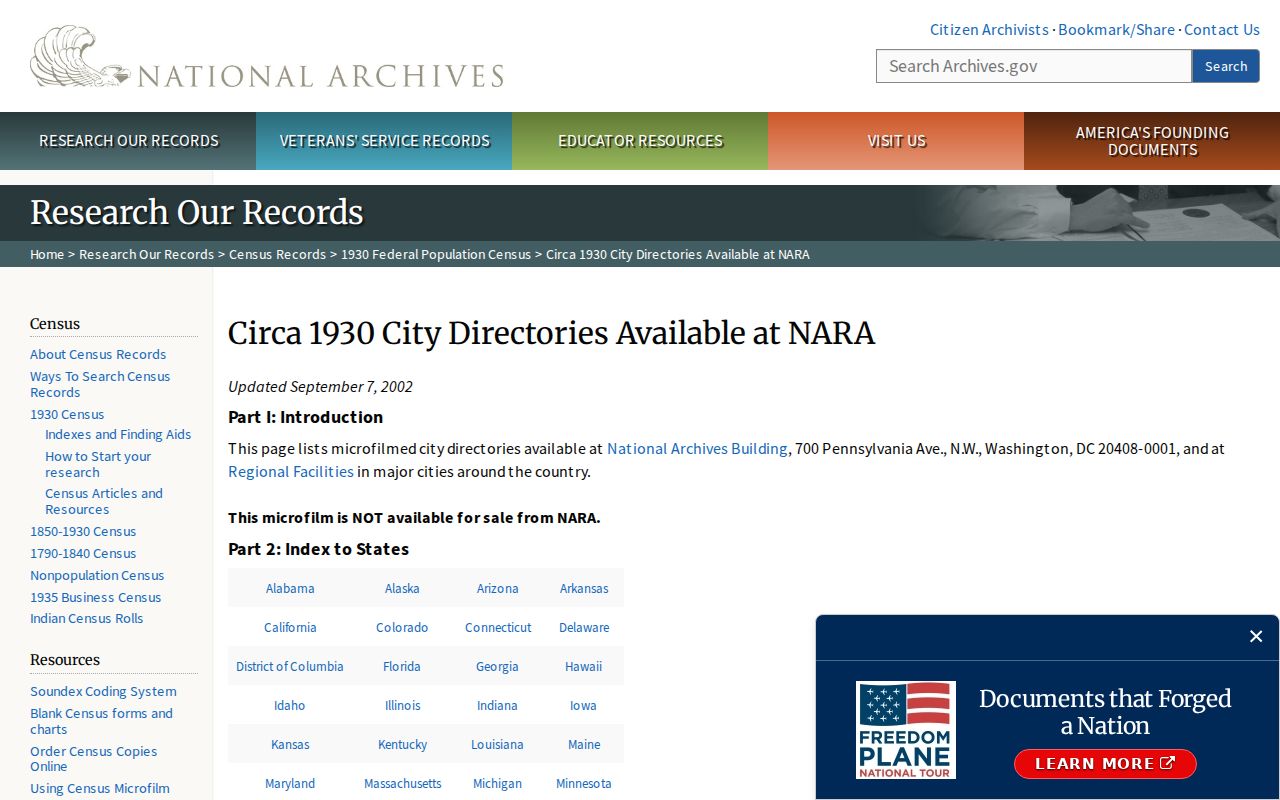
The inventory establishes the named years and places. It does not provide a complete page image or a publisher history for every volume. Capture the exact title and repository note, then preserve the place names printed in the volume when searching other records.
Orange County Archives South County
Orange County Archives is the local fallback when a directory title is not obvious online. The Old Courthouse location is 211 W. Santa Ana Boulevard, Room 101, and the research notes list (714) 834-2536 with historical weekday hours of 9 to noon and 1 to 4:30. The archive holds county directories, newspapers and magazines, deeds and vital material, maps, photographs, audiovisual material, and affiliated-agency collections. It was created in 1983 and moved under the Clerk-Recorder in 1995.
The catalog gives collection descriptions, not universal scans. Ask staff to check South Orange County coverage and to look for Dana Point, Capistrano Beach, and neighboring place names. A catalog title may describe the county or a regional series without naming every community inside it. Request the years and format actually held, whether a reader is needed, and whether staff can identify a street or surname index. That question keeps a missing title from being mistaken for a missing resident.
The archive’s scale is useful context, not proof of a particular volume: county reporting described more than 7,800 linear or area square feet and over 600 monthly inquiries. Bring a target surname, an address, and a narrow date range. Historical directories work best when the archive search is paired with a newspaper or census check.
The Orange County Archives collection gateway is the source to use when asking for South County coverage.
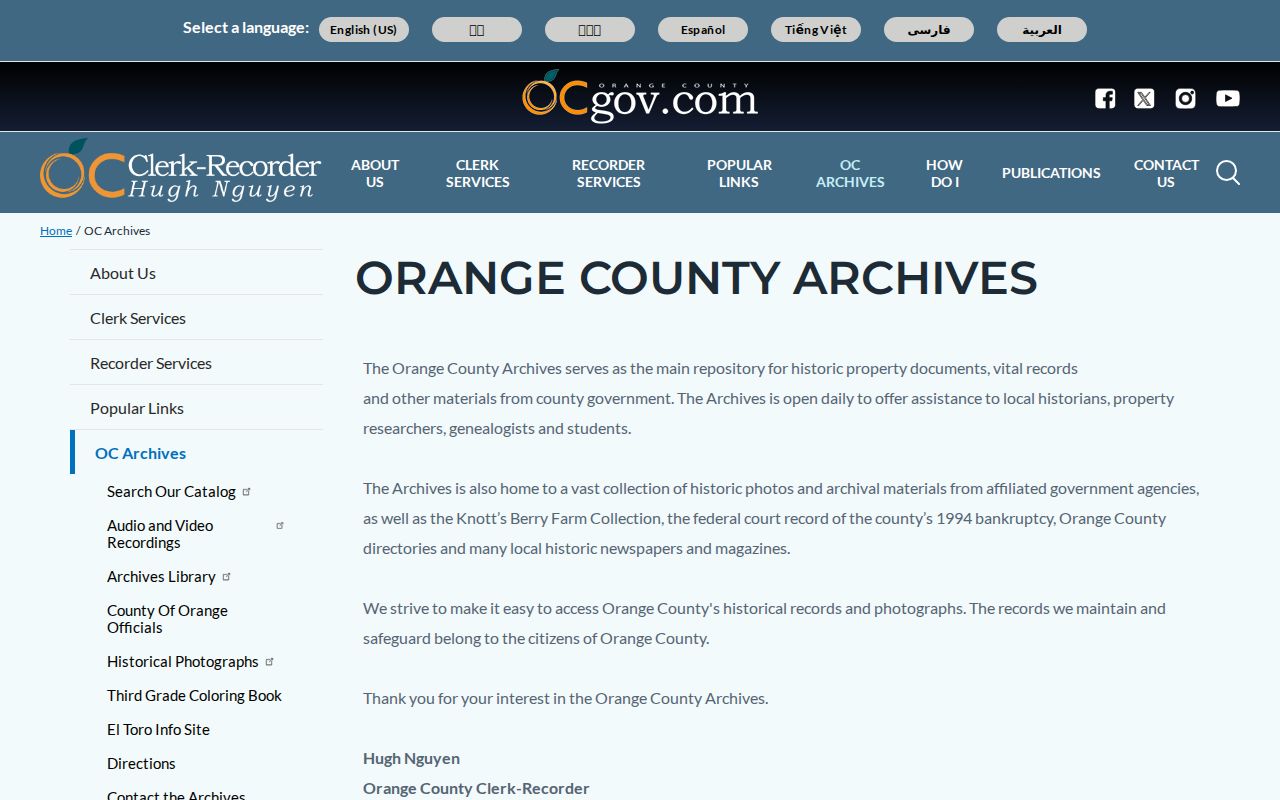
The archive image represents a collection gateway, not an assurance that every Dana Point directory is digitized. South County wording is the practical request tip.
Note: Archive catalog language can describe a county series without naming each community printed inside it.
Dana Point Library Began in 1938
The Dana Point Library has its own useful records story. It opened on October 1, 1938, in a post office, moved in 1950 and again in 1957, and opened its current building on July 6, 1977. The branch was called Dana Niguel for a period and reverted to Dana Point in 1998. Those changes matter when a catalog, newspaper notice, or family note uses an older branch name. The OCPL timeline preserves that sequence.
The Dana Point Library branch page lists 33841 Niguel Road and (949) 496-5517. Listed hours are Monday through Thursday, 10 to 7, and Friday and Saturday, 9 to 5.
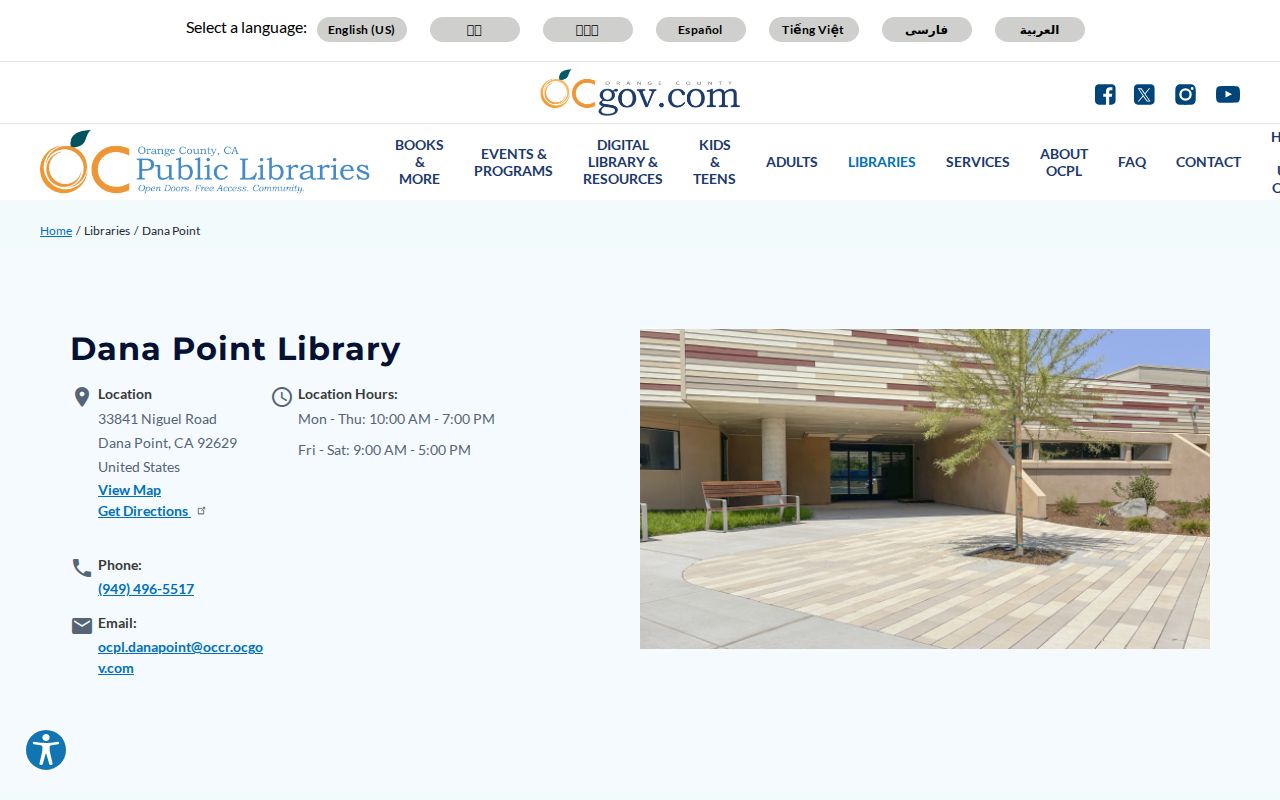
A library that began in a post office became a long-term research gateway. Ask the branch or its catalog for the local-history, newspaper, directory, yearbook, and obituary holdings that are not published as a complete shelf list.
Dana Point Digital City Directories
Orange County Public Libraries provides in-branch Ancestry Library Edition, Fold3, and HeritageQuest to full-privileges cardholders. Public computers support on-site use of those licensed databases. A Dana Point cultural report confirms that researchers used “Dana City Directories” through Ancestry, but the available research does not state the years, publishers, or a complete run. Search access therefore exists without proving that every volume or every page is present.
The OCPL history and genealogy database page is the source for the branch access boundary.
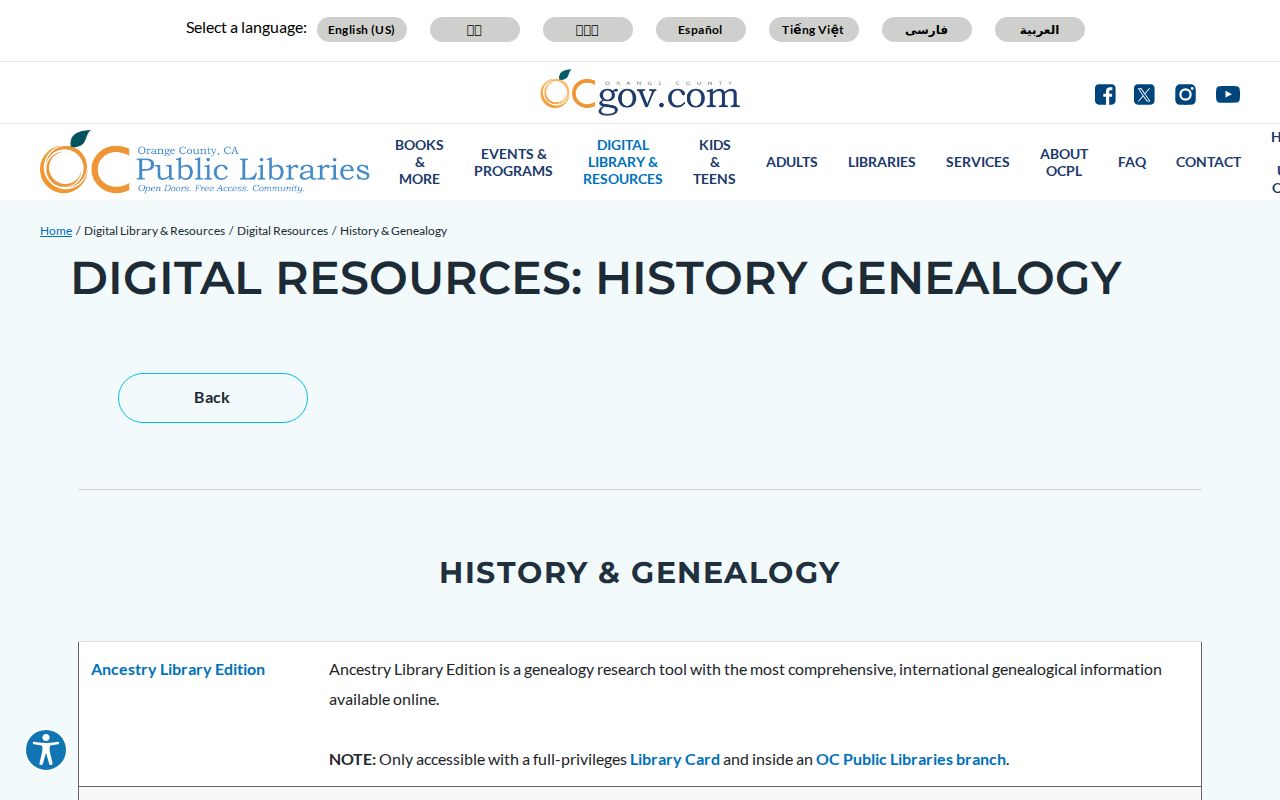
Use the branch session to search a surname, given initial, street phrase, or nearby place name. Save the volume title and page reference as you work. A result without a visible page image still needs a second source, and a blank result does not establish that a person was absent.
Dana Point Newspaper Clues
Digital newspapers fill the years between directories and census schedules. OCPL describes the resource as in-library access, with selected issues from the 1920s through 2021. Newspaper columns can supply an obituary or funeral notice, marriage announcement, club or school item, property or legal notice, proprietor name, address, and social connection. They are clues to test, not a substitute for a certificate or a complete household roll.
- Dana Point News, listed for in-library access.
- Capistrano Valley News.
- Coastline Dispatch, 1931 to 1968.
- San Clemente News, 1987 to 1989.
- San Clemente Sun-Post, 1937 to 2021.
- South Coast News, 1919 to 1989.
- Laguna Beach titles, 1919 to 1989.
The OCPL Digital Newspapers collection shows why a Dana Point search should include nearby title names.

Search the person, street, organization, and place together. A Capistrano Beach notice may be the bridge to a Dana Point household, while a San Clemente or South Coast item may supply the date needed to read a directory change correctly.
Note: Newspaper coverage can bridge years between directories, but it remains a clue until another record confirms it.
Reading Dana Point Directory Entries
No actual Dana Point page was accessible without a licensed Ancestry session, so no fictitious historical entry belongs in a search result. Use the first volume page as an inspection checklist. Record the surname and given initial, spouse or widow notation, occupation, home or business address, any owner or occupancy mark, death or removal note, cross-reference, and reverse street section. The point is to preserve what the printed line says before translating it into a family story.
| Name | Copy the surname, given name or initial, and spelling exactly. |
|---|---|
| Household clue | Note a spouse in parentheses, a widow notation, or another relationship mark. |
| Occupation | Record the occupation or business detail as printed, without treating it as proof of identity. |
| Address | Copy the house number, street, and every original abbreviation. |
| Occupancy mark | Capture any owner or occupancy symbol and read the volume’s key before interpreting it. |
| Status clue | Flag a death, removal, or cross-reference for confirmation elsewhere. |
| Street section | Check whether the volume has a reverse address-to-occupant section. |
Photograph or transcribe the title page, publication year, publisher if printed, and abbreviation key before copying an entry. A missing name may mean a move, death, nonlisting, a different place label, or a missed spelling variant. Property ownership and occupancy are separate questions, so use the entry as a lead and confirm it with a census, newspaper, marriage, death, or deed record.
Dana Point Directory Terms
Historical volumes use compact labels. These definitions keep a search from treating an index, a street list, and a household clue as the same kind of evidence.
- Criss-cross directory
- A reverse section arranged by street or address instead of surname. The available research does not verify which Dana Point years survive.
- Householder index
- A name-to-address aid centered on a household head. Coverage and format depend on the volume.
- Abbreviation key
- The publisher’s legend for shortened occupations, relationships, and address terms. Read it before expanding a mark.
- Directory entry
- A dated historical clue about a person or place, not certified proof of present occupancy.
Searches also need local vocabulary. S. H. Woodruff’s 1920s planned “Mediterranean village” and the Lantern District’s named streets left address forms that may be shortened in an index. Test complete forms such as “Street of the Green Lantern” and “Street of the Blue Lantern,” then the documented Ruby, Amber, Violet, Golden, Silver, Copper, and Crystal Lantern variants, including abbreviated “Street of” forms.
Tracing Dana Point City Directories
Pair a directory with a census instead of reading either source alone. The clearest worked comparison is a 1929 directory and the 1930 federal census. Publication and enumeration do not occur on the same day, so an address or household can shift between the two. Use the sequence below to preserve the difference.
- Start with the 1929 volume and write down the full name, initial, address, occupation, household clue, and every abbreviation.
- Check the street-order or criss-cross section, if that volume has one, to find the address and nearby names.
- Pair the directory line with the 1930 census household for the same area, while allowing for publication lag and a changed address.
- Test the 1926 and 1931 NARA years, then split same-name people with marriage, death, newspaper, and place-name evidence.
- Close the trail with later directories, permits, deeds, obituaries, or a death and burial permit index.
The Orange County FamilySearch Center at 674 S. Yorba Street in Orange is an in-person fallback with (714) 997-7710, 24 computers, more than 6,000 books, maps, and periodicals, volunteers, and scanning help. Listed hours are Monday 10 to 2, Tuesday through Thursday 10 to 6, and Friday and Saturday 10 to 4. Research notes identify Orange County marriage indexes from 1889 to 1951, records through 1953, and a death and burial permit index from 1889 to 1955. The 1950 census is the latest federal census available under the 72-year rule. Search Dana Point, Capistrano Beach, Monarch Beach, Doheny, San Juan Capistrano, and broader Orange County labels.
If a name disappears, test a move, death, nonlisting, or a changed spelling before drawing a conclusion. A newspaper notice can date the change, a marriage or death index can separate two people, and a deed can test ownership without proving who occupied the home.
Note: A household that disappears from one volume may have moved, died, or been omitted, so test each possibility.
Dana Point Historical Society Clues
The Dana Point Historical Society, founded in 1987, preserves more than 200 years of local interpretation, thousands of photographs, artifacts, exhibits, film dating from about 1900, and stories about families, maritime life, surfing, Woodruff, and Richard Henry Dana. The museum and archive is at 33282 Golden Lantern, Suite 104. Listed access is Tuesday, Thursday, and Saturday from 1 to 3, except holidays and special events. Contact is (949) 248-8121 or contact@danapointhistorical.org. Group tours by appointment are $5 per person.
The Dana Point Historical Society collections page is the right starting point for exhibits, history material, and archive access.

Photographs and captions can connect a named person to a building, boat, street, or event when a directory is silent. The society’s under-two-mile historic walking tour emphasizes Woodruff’s 1920s village and the Lantern streets. Those captions are people-and-place evidence, not a current resident roll. The society’s photo browse archive can supply a date or spelling to carry into a directory search.
Where Dana Point Directory Trails End
A historical directory is a lead, not a closed case. The verified evidence does not supply a publisher list, an exhaustive later run, exact reverse-directory years, a complete yearbook or obituary shelf list, or a Sanborn sheet assignment. When the shelf ends, move to the next record type and keep the gap visible. The Orange County Clerk-Recorder handles recorded property and vital services, while RecorderWorks indexes recorded instruments from January 4, 1982, forward. The index shows no images, staff do not perform the name search, and pre-1982 copy requests need a book, page, or instrument reference when available.
| August 1, 1889 | Orange County began operation after separating from Los Angeles County; earlier Dana Point evidence may sit under the predecessor jurisdiction. |
|---|---|
| 1926, 1929, 1931 | NARA names Dana Point, Capistrano Beach, and San Juan Capistrano in Orange County directories. |
| October 1, 1938 | Dana Point Library opened in a post office, beginning its documented branch history. |
| 1950 | The latest federal census currently public under the 72-year access rule. |
| 1987 | Dana Point Historical Society founded and began preserving local photographs, artifacts, and stories. |
| 1989 | Dana Point incorporated, beginning the city’s own municipal record trail. |
For a current address question, shift to the Dana Point street directory and modern parcel records rather than stretching a historical volume past what it can show. That handoff keeps a 1929 household clue, a 1930 census match, and a later address record in their proper time and place.