
Starting a Dana Point Residents Search
A Dana Point residents directory search works best when the question comes first. A current owner question starts with an address and parcel. A person question needs two independent facts, such as a deed party and a court or license record. A family-history question may start with a directory, newspaper, marriage index, or census instead. No single Orange County screen lists every household. Owners, occupants, voters, business contacts, and past residents appear in different records, and some records are purpose-limited or confidential.
Use the narrowest route that matches the goal. The county assessor web roll gives property facts by APN, but it suppresses owner names. RecorderWorks supplies a grantor and grantee index, not a deed image. The voter portal is for a person checking that person's own registration, while a larger voter file needs a statutory application. City permits can date work at a property, yet an applicant is not proof of residence. Historical volumes fill older gaps but can use Capistrano Beach or Orange County labels instead of the modern city name.
- Write down the known name, street, parcel, time period, or family link before searching.
- Use Community View to connect a street address with its APN when the question is property-based.
- Check the county index or court route that fits the record, then note the record number and date.
- Compare a second independent source, such as a permit, license, directory, vital index, or newspaper.
- Ask the custodian for a copy or correction when an index is not the record itself.
Offices Behind Dana Point Resident Records
Dana Point has no separate recorder, assessor, vital-records bureau, or municipal court. The practical Dana Point residents directory trail crosses City Hall, Orange County offices, and California agencies. The Dana Point City Clerk keeps council and municipal records, while the Orange County Clerk-Recorder handles deeds, certificates, fictitious business names, and related filings. The Assessor supplies the parcel and roll side. The Registrar of Voters controls voter access, and Superior Court handles cases.
Dana Point City Clerk
33282 Golden Lantern, Suite 203
Dana Point, CA 92629-1805
(949) 248-3501
Mon-Thu 7:30-5:30; Fri 7:30-4:30
Orange County Assessor
500 S. Main St., 2nd Floor
Orange, CA 92868
Mon-Fri 8:00-5:00
Orange County Registrar
1300 S. Grand Avenue, Building C
Santa Ana, CA 92705
(714) 567-7600
Voter access by approved route
Dana Point Address to APN
Community View is the practical first stop for an address-led Dana Point residents directory search. Search the street number and name without adding a city, state, or ZIP. A street-only search moves the map to a vicinity. Zoom until the parcel lines show, click the target boundary, and save the address and nine-digit APN from the pop-up. The bubble can also show property details, zoning, a summary, aerial or Bing links, and layer attributes. It is a map bridge, not a resident card.
The APN is the county's parcel key. It can connect a map to the Assessor roll, RecorderWorks, permits, and a legal description. The Assessor's public web screen accepts exactly eight numeric APN digits and has a Submit button. It does not accept an owner name or a street browse, and its result omits the owner. For fuller lawful ownership or mailing detail, use the Assessor counter or the most recent recorded instrument. A mailing address can differ from the situs, which is the physical land address.
Orange County's parcel search and Dana Point's Community View use different APN formats. Follow each interface instead of forcing one number into the other. If a parcel was split or merged, the recorded lot, block, tract, parcel-map reference, or metes-and-bounds description is the steadier bridge.
A view of the Orange County Assessor gateway shows why the APN step matters. The current web roll gives basic property, assessed value, exemption, and roll-date facts, but later changes may not appear until a later roll or counter inquiry. The result is useful context, not proof of who lives in the home.
- Roll
- An official list or snapshot of a defined record set, such as assessed parcels or registered voters.
- Index
- A finding aid with names, dates, types, or reference numbers; it points to a record but may not contain the record image.
- Parcel
- A defined piece of land tied to a boundary, APN, legal description, and situs address.
- Criss-cross directory
- A historical reverse directory arranged from a street address to a householder or occupant entry.

The Assessor view helps separate a parcel question from an occupant question. Carry the APN into the next record rather than treating the map result as a complete directory.
Dana Point Recorder Index Trail
RecorderWorks is the Orange County Clerk-Recorder's grantor and grantee index. A grantor transfers an interest; a grantee receives one. Search the party name in LAST FIRST form, allow a partial first name when needed, and narrow by recording dates. The portal also accepts document number, APN, legal-description, and older index-book routes. It covers computerized records from January 4, 1982 forward. It is an index, so a document-number click opens metadata rather than an online image.
| Party type | Individual or business context, selected when required |
|---|---|
| Name | LAST FIRST, no punctuation; last name alone can work |
| Recording dates | Optional MM/DD/YYYY start and end dates |
| Document route | Instrument number, APN, legal description, or document type |
| Older route | Display Index and Display Fiche Cell for book and fiche references |
Record the party role, document type, recording date, number, APN or legal description, and any related instrument. The portal has page-size options, result-format choices, short-description display, and name-combination display. Recorder staff will not perform the search for a caller, visitor, or mail requester. Search at an office kiosk or bring a known reference when ordering a copy.
The official Orange County grantor-grantee index is the starting point for a deed trail, not the end. A private-party result was not used as a sample. That restraint matters because an index can identify a recorded event without showing signatures, full legal language, or every occupant.
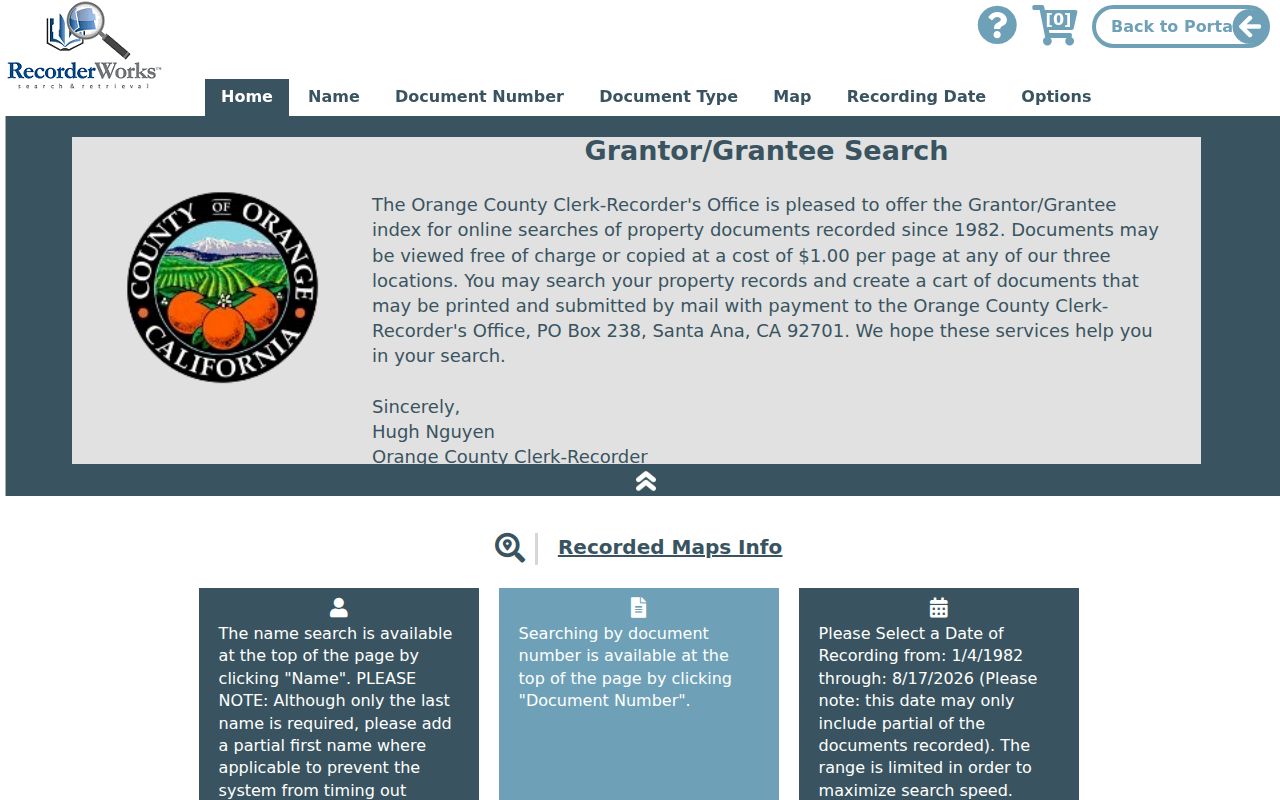
The RecorderWorks screen makes the index-versus-image distinction visible. Use the reference it returns to request the official instrument when the record itself matters.
When Dana Point Indexes End
Pre-1982 recorded documents need a different handoff. Orange County keeps older book and page references in Santa Ana index books or microfiche. A requester must identify the reference. Copies can be ordered from the Clerk-Recorder by mail with a self-addressed stamped envelope and payment. The researched official copy rate is $1 per page plus $1 for certification or a document or map. A certified copy is a custodian-attested reproduction. It is not the same thing as a free index entry.
For title, start with RecorderWorks or the older index and preserve the named parties, date, type, and reference. For the parcel, use Community View and the APN route to retain the situs, boundary, and legal link. For the official copy, use the Clerk-Recorder request path for a deed or map image and certification. Orange County Archives adds historic deeds, maps, directories, newspapers, photographs, and vital material from county history. The archive catalog is collection-specific, not a promise that every page is scanned. Ask for South Orange County material when a title does not say Dana Point.
Note: The January 1982 imaging handoff is a search boundary, not proof that an older record is missing.
Dana Point Voter Records
The Orange County Registrar of Voters does not publish an open street directory. A person checking that person's own registration uses the Your Voter Information form with date of birth, the last four digits of a California driver license or ID, or the last four digits of an SSN when no ID exists, plus the first three letters of the first name. After verification, the self-service result can show status, name, mailing address, party, history, districts, and elected officials.
A qualified voter-data request is a separate statutory route. The application needs a wet signature, permitted-purpose narrative, supporting proof, security and confidentiality details, photo ID, and prepayment. It can identify up to ten voters in a specific-record request, but there is no fixed turnaround. The full file can contain residence, mailing, precinct, registration, status, and participation fields, yet driver-license, SSN, signature, and other protected identifiers stay closed. Safe at Home participants use confidential registration and may be omitted from public-purpose files.
For a current voter question, use the Orange County self-lookup only with the registrant's own credentials. Elections Code sections 2187, 2194 and 2 CCR section 19003 limit qualified data use. A lawful purpose does not turn voter data into a general neighbor list.
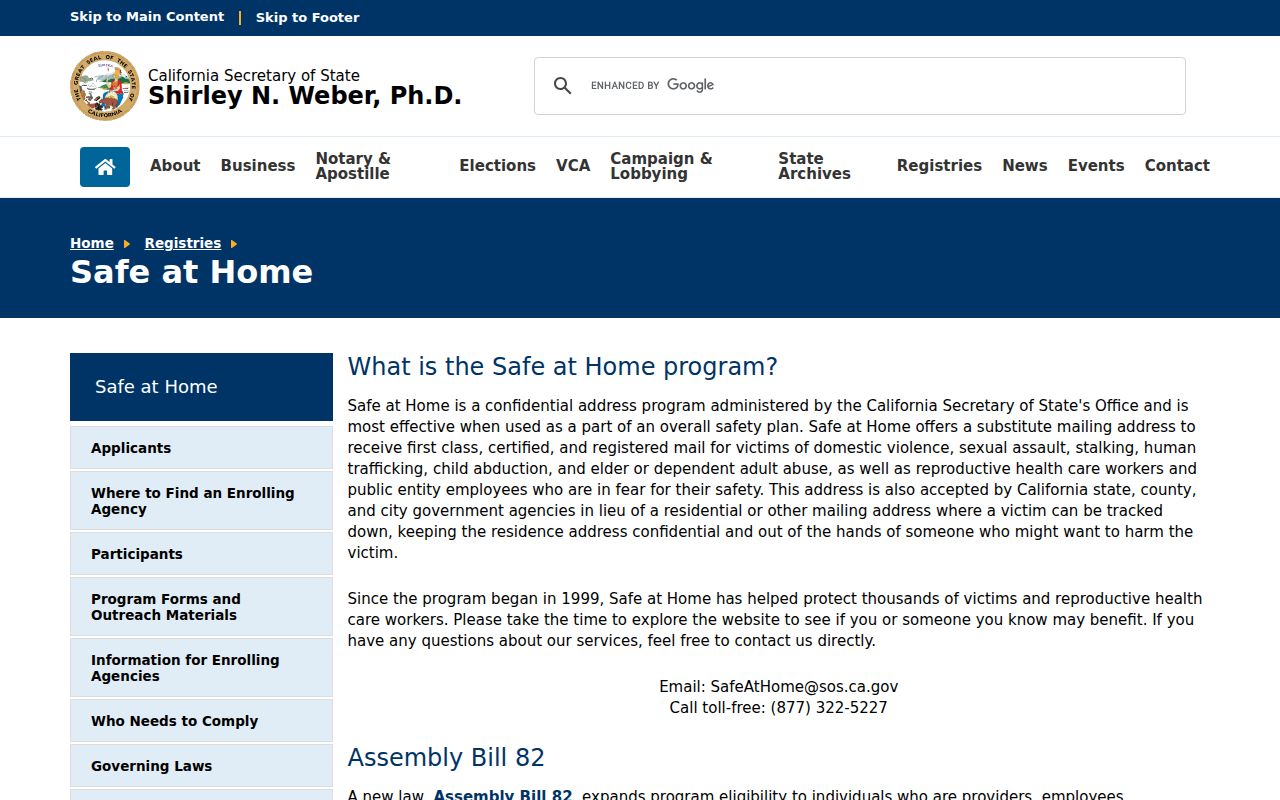
The California Safe at Home resource explains why a normal address search may not reveal a protected participant. Confidentiality is an access rule, not a data error.
Dana Point Sources for Current Residents
Current records describe different relationships to Dana Point. A property roll is about a parcel and value. A deed index is about recorded parties. A voter record is about registration. A permit is about a project and its applicant or contractor. A court or custody record concerns a case or booking, not a household. A business or professional license ties a person to an official role. These are useful resident-directory paths only when the question matches the record.
| Source | Relationship shown | Keeper | Access boundary |
|---|---|---|---|
| Assessor secured roll | Parcel values and exemptions | Orange County Assessor | APN web result; owner detail at counter |
| Recorder index | Grantors, grantees, instruments | Clerk-Recorder | Free index; copy request for image |
| Voter self-lookup | Registrant's own status and address | Registrar of Voters | Authenticated self-service |
| City permit record | Property project and applicant clues | Dana Point Building and Safety | eTRAKiT and counter review |
| Business or license record | Entity role or credential | California agencies | Public fields vary by program |
That division is why a name search needs care. An LLC or trust can be the deed party. An off-site mailing address can show ownership without occupancy. A permit contact can be an architect, contractor, owner, or applicant. A directory entry can show a past household but not today's occupants. The Dana Point resident lookup path is the better fit when one person, rather than one parcel, is the question.
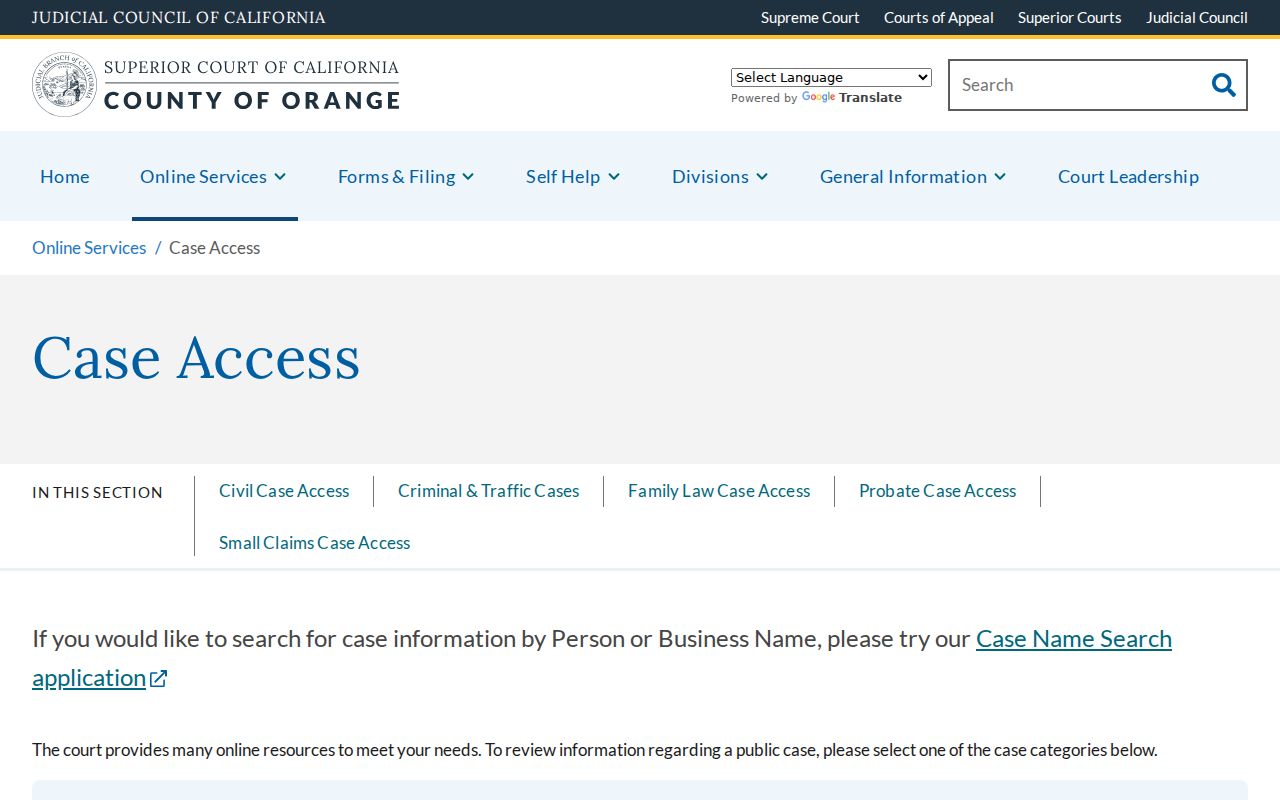
Orange County court access is one more record route with its own case-number and confidentiality rules. It should corroborate an identity, not stand in for a resident roll.
Dana Point Court and Vital Records
Dana Point matters go to Orange County Superior Court. Case Access is mainly case-number driven. The Calendar route can accept a party name in its own context. Enrolled Case Name Search uses an account and credits, limits results to 500, refreshes daily, and has a short daily downtime window around 2:00 to 2:15 a.m. Pacific. Sealed, confidential, juvenile, adoption, paternity, and other restricted matters do not become public because a name is known. The Central Justice Center Records Unit also offers a terminal and copy-request route.
Vital records follow a different rule. Orange County issues county birth and death certificates and marriages licensed there. California Department of Public Health handles statewide applications. Authorized and informational copies differ, confidential marriage records do not have an informational copy, and adoption or original birth records require a statutory or court process. The 2026 state fees in the research are $31 for birth, $26 for death, $19 for marriage, and $18 for dissolution certificates. The state application route is at California Vital Records.
Historical indexes can identify an event without granting access to a certificate. California marriage indexes cover 1849-1957 in the cited collection, while Orange County marriage and death or burial permit indexes have their own ranges. Treat the index as a lead and the certified copy as a separate request.
Dana Point City Hall Records
Dana Point's local record trail begins with incorporation in 1989. City Hall holds council agendas, minutes, actions, municipal and zoning codes, political reports, permits, planning records, contracts, leases, code files, and administrative material. The public-record form allows email, fax, mail, or counter submission. It asks for a description and time period, and it offers email, review, or printed delivery. An address request can name one property street address and parcel number, then select permits, plans, geotechnical reports, code violations, or another record type.
Fees in the researched form include $0.10 per paper page, $0.20 for microfilm or microfiche, $0.50 for fax, $6 for large format, and applicable postage or statutory charges. A building record search only is $22 plus copies, and certification is $5. Plans may be viewed but not copied or distributed without written owner and design-professional permission under Health and Safety Code section 19851. The city must make a CPRA determination within ten calendar days, but that is not a production deadline.
The Dana Point records-management page is the right fallback when a city record is not online. It is distinct from the county route. Permits can date work and show project contacts, but they do not establish every resident in a home.
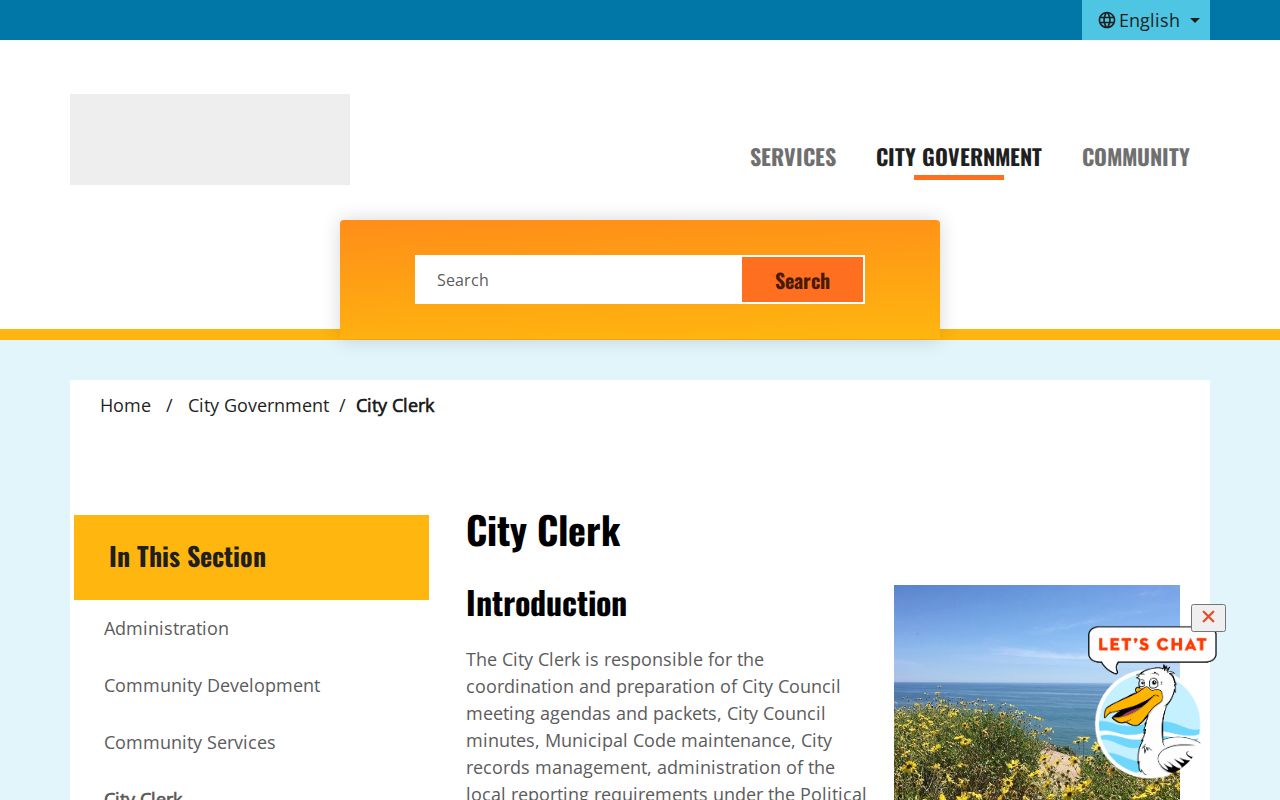
The City Clerk gateway points toward the municipal side of a Dana Point search. It helps keep city, county, and state custodians separate.
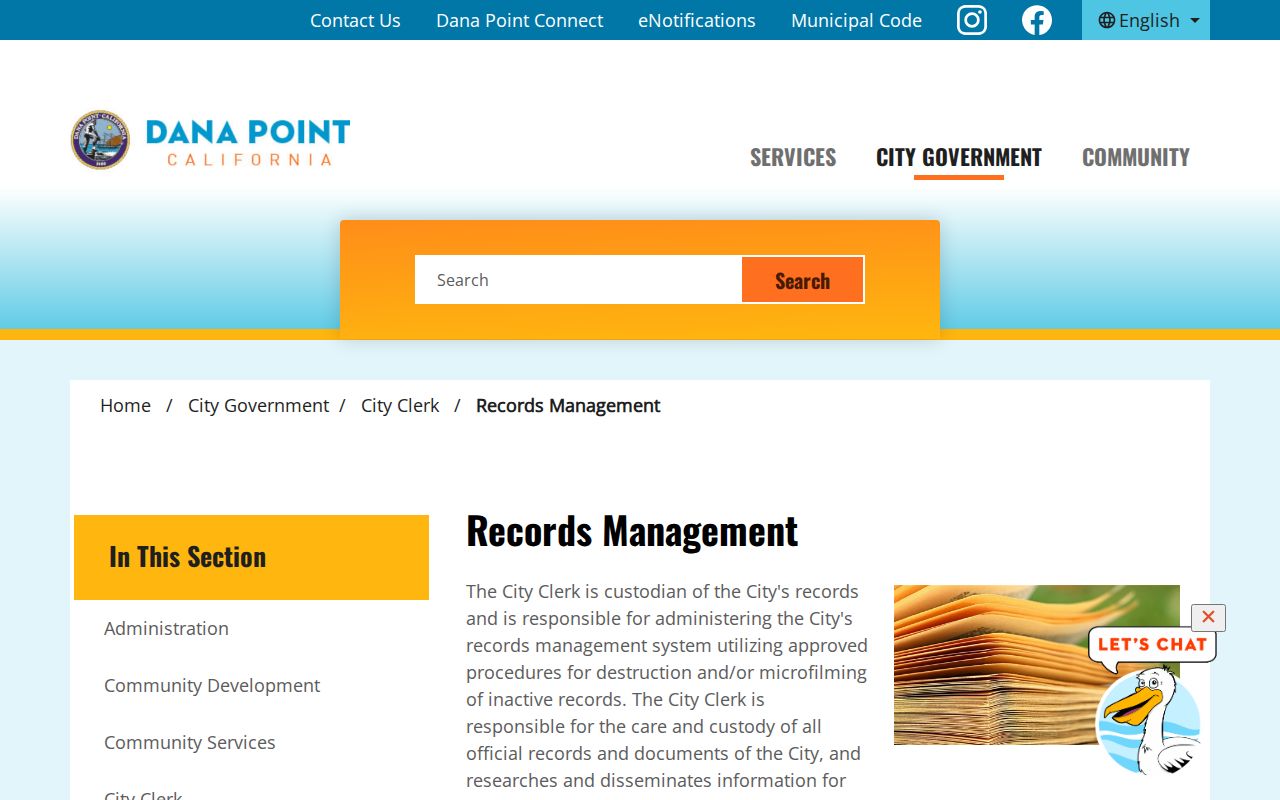
Records-management guidance is useful when the online index ends and a focused request is needed. State the address, record type, and date range to reduce delay.
Dana Point ZIP Geography
Two ordinary ZIP identities serve Dana Point in the verified city, county, and USPS material. ZIP 92629 covers central Dana Point, the Lantern District and Village, Dana Hills, the Harbor and Headlands, and much of Monarch Beach, Sea Canyon, and Dana Knoll. ZIP 92624 serves Capistrano Beach and the southern Dana Point and Doheny Village edge. Capistrano Beach is a postal locality, but 92624 addresses can still sit inside incorporated Dana Point.
ZIP geography is delivery geography, not a city boundary. The Dana Point Harbor is within city geography but is county-administered. USPS address mode is decisive for a specific property. A ZIP-wide resident directory does not exist through the Assessor, RecorderWorks, or Community View. The voter file can contain ZIP and address fields only through a qualified access route. Use the ZIP to narrow a question, then move to the parcel or person record that actually supports it.
ZIP 92629 uses the Dana Point Post Office at 24551 Del Prado, Dana Point, CA 92629-9998, (949) 496-2787. ZIP 92624 uses the Capistrano Beach Post Office at 34281 Doheny Park Road, Capistrano Beach, CA 92624-2200. Verify one delivery address with USPS before treating a ZIP as a search clue.
Dana Point Search Results
Official records and commercial compilations answer different questions. A government index has a named custodian, a defined field set, and a legal access boundary. A commercial compilation may merge names, lag a change, or attach an old address without showing its source. Neither should be treated as a complete Dana Point residents directory. A strong search preserves the source, date, record number, and reason the record supports the conclusion.
| Source type | Strength | Limit |
|---|---|---|
| County or city record | Named custodian and defined fields | May show only owners, parties, projects, or registrants |
| Historical directory | Past address and household context | Publication lag and missing years |
| Commercial compilation | May offer a broad starting clue | Source, freshness, and lawful-use limits can be unclear |
The local fraud trail offers a useful safety example. Orange County's Clerk-Recorder courtesy notices are automatic and free, with the first recorded page for a title-affecting instrument. They supplement, rather than replace, a periodic grantor-grantee check. A record search should also be alert to impostor letters, advance-fee demands, and unclaimed-property claims that ask for payment before a person has verified the official channel.
Note: A record can be public and still be wrong, stale, incomplete, or unrelated to the person being sought.
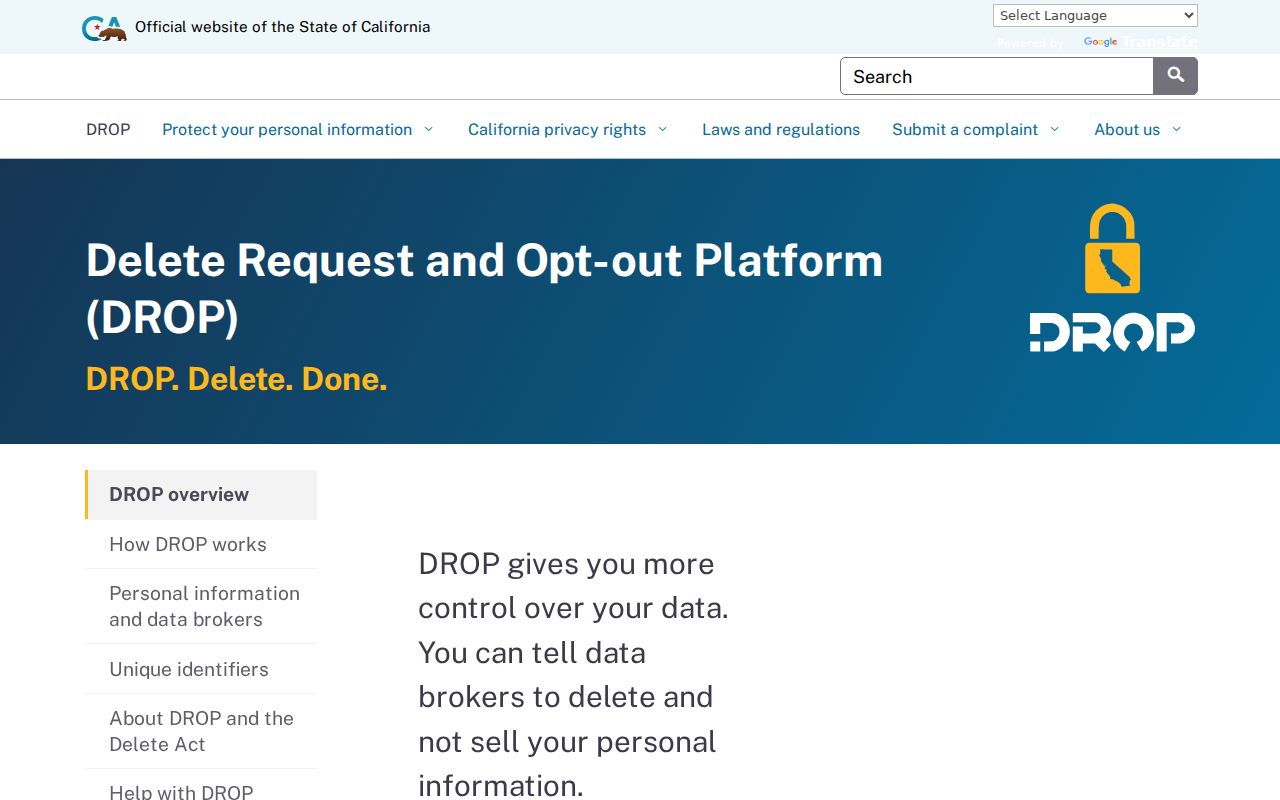
California's DROP portal gives residents a single route for registered data brokers, but it does not erase deeds, court files, or other government-held source records.
Dana Point's Historical Directory Shelf
The historical Dana Point residents directory shelf is regional because the city was incorporated only in 1989. The National Archives inventory explicitly places Dana Point, Capistrano Beach, and San Juan Capistrano in Orange County directories for 1926, 1929, and 1931. Orange County Archives holds county directories, newspapers, deeds, maps, photographs, and vital material, but its catalog is collection-specific. The Dana Point Library provides branch access to Ancestry Library Edition, Fold3, and HeritageQuest for eligible cardholders, plus in-library digital newspapers that include Dana Point News and other South Coast titles.
A directory can show a name, initial, spouse or widow notation, occupation, home or business address, owner or renter mark, and cross-reference. A street section may reverse an address into an occupant. It can place a household between census years, but it is not a current resident list and it does not prove ownership. Search Dana Point, Capistrano Beach, Monarch Beach, San Juan Capistrano, and broader Orange County labels when the era predates cityhood.
The Orange County Library's local-history story adds texture: its Dana Point branch began in a post office in 1938, moved twice, and opened its current building in 1977. The OCPL history and genealogy resources are a practical place to ask about licensed databases and local shelf material. The Dana Point city directory page carries the full historical-shelf treatment.
Dana Point Records Handoffs
Three dates organize the older Dana Point residents directory trail. Orange County began operating after its separation from Los Angeles County on August 1, 1889. Before that boundary, deeds, court files, and probate material for the area may be filed under Los Angeles County or a predecessor jurisdiction. Dana Point's own municipal trail begins with 1989 incorporation. The recorder's online index begins January 4, 1982, with older books and microfiche behind a different search step.
These are geographic and administrative handoffs, not a local courthouse disaster story. No authoritative research found a fire or flood that destroyed a defined Dana Point or Orange County series. When a modern search fails, test the older place name, the county custodian, the county seat, the archive catalog, the library shelf, and the request form before calling the record missing.
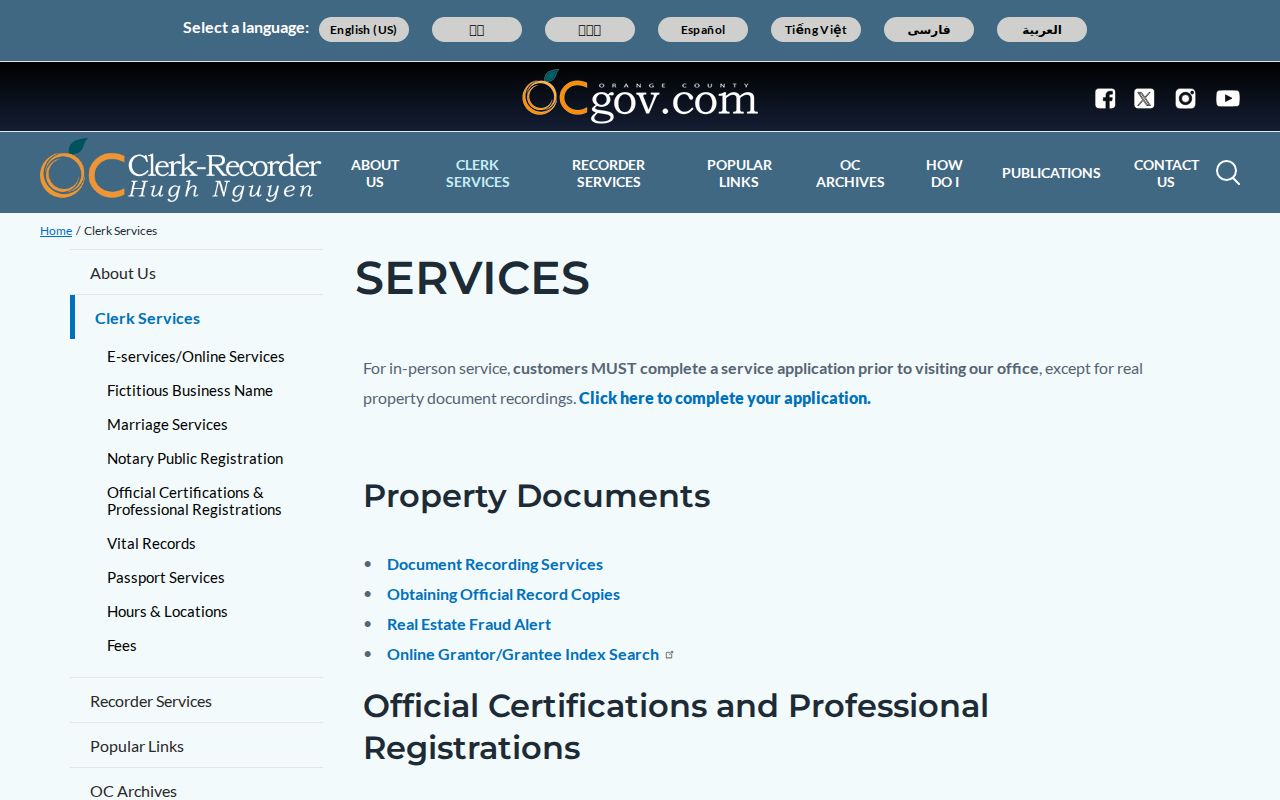
County Clerk-Recorder services show how deeds, certificates, fictitious business names, and related filings share a custodian even when their access rules differ.
Offline Dana Point Records
When an online screen stops short, use the channel named for that record. The city accepts public-record requests by email, fax, mail, or counter. The Clerk-Recorder supports counter and mail copy requests after a requester identifies a reference. The Assessor has public counters in Orange and Mission Viejo. Superior Court's Records Unit has a counter, terminals, phone, email, and copy process. The library, Historical Society, FamilySearch Center, and Orange County Archives add shelves, microfilm, local newspapers, photographs, and volunteers.
Keep a search log. Note the source URL, the date checked, the APN or case number, the exact place label, and what the record did not show. That small habit prevents a deed party from becoming an assumed occupant, a voter result from becoming a household list, or a directory entry from being treated as current. It also gives a custodian enough detail to answer a focused request.
The result is a more honest Dana Point residents directory: not one giant list, but a set of official paths that disclose different facts. Start with the record that fits the question, use a second source to test identity or time, and stop where the law or the custodian's rules stop.